Category: Travel and Wellness | Reading Time: ~6 min
Table of Contents
- When Travel Becomes a Practice
- Why India Remains the World’s Yoga Capital
- What a Yoga Retreat Actually Looks Like
- Rishikesh: The Heartbeat of Yoga Travel
- Beyond Rishikesh: India’s Other Yoga Destinations
- What Travellers Are Really Looking For
- How to Choose the Right Retreat
- FAQs
Something is shifting in the way people travel.
The era of the purely sightseeing holiday is giving way to something far more intentional. Travellers are increasingly asking not just where to go, but what they want to feel, learn, and carry home when they leave.
Yoga retreats in India are at the centre of that shift. India’s wellness tourism market is projected to reach USD 27.5 billion by 2025, according to the Global Wellness Institute, with yoga and Ayurveda-based travel among its fastest-growing segments.
This is not a trend. It is a transformation in what travel means. And India, with its unbroken 5,000-year lineage of yogic wisdom, is uniquely positioned to lead it.
H2: When Travel Becomes a Practice
There is a meaningful difference between taking a yoga class on holiday and going on a yoga retreat.
The first adds movement to a holiday. The second reorganises the entire journey around inner work. The poses, the breath, the philosophy, the silence, the community, and the landscape all work together toward something a two-week beach holiday simply cannot offer.
The surprising truth? Most people who attend yoga retreats in India report that the transformation had very little to do with flexibility. They describe sleeping better than they have in years, thinking more clearly, and feeling a kind of stillness they had forgotten was possible.
Research published in the Journal of Alternative and Complementary Medicine found that immersive yoga retreat experiences produced significantly greater reductions in perceived stress, anxiety, and depression compared to regular outpatient yoga classes. The effects persisted for months after the retreat ended.
The immersion matters. The environment matters. The intentionality of the travel itself matters.
H2: Why India Remains the World’s Yoga Capital
India is not simply a destination for yoga tourism. It is the source.
The Yoga Sutras of Patanjali, the Hatha Yoga Pradipika, and the Bhagavad Gita all emerged from this land. The teaching lineages that now span the entire globe trace their roots to specific ashrams, specific riverbanks, and specific teachers in specific Indian cities.
You might be wondering what makes practicing yoga in India different from practicing at a studio back home. The answer is context.
When you practice pranayama in a shala overlooking the Ganges at sunrise, or study yogic philosophy in the same Himalayan foothills where Patanjali encoded the Sutras, the practice stops being abstract. It becomes lived. It becomes real in a way that no amount of studio classes can replicate.
Beyond the spiritual dimension, India offers extraordinary practical value for wellness travellers. World-class retreat centres, deeply experienced teachers, Ayurvedic clinics, and mountain environments all combine at a price point that makes extended immersive stays genuinely accessible for international travellers.
Alt text: Aerial view of Rishikesh, India at sunrise, the yoga capital of the world and top destination for yoga retreats and wellness travel
H2: What a Yoga Retreat Actually Looks Like
Many first-time retreat travellers arrive with one of two misconceptions. Either they expect a luxury spa holiday with some sun salutations bolted on. Or they expect a punishing ascetic experience of cold showers, silence, and 4 AM wakeups.
The reality of a well-designed yoga retreat sits comfortably between these extremes.
A typical day at a quality yoga retreat in India might look like this:
- 5:30 AM: Wake up during Brahma Muhurta, the pre-sunrise hour considered optimal for practice in classical yoga tradition
- 6:00 AM: Pranayama and meditation session
- 7:30 AM: Morning asana practice, typically 90 minutes
- 9:30 AM: Sattvic breakfast, freshly prepared and eaten in mindful silence or gentle community
- 11:00 AM: Philosophy lecture, anatomy class, or workshop depending on the programme
- 1:00 PM: Lunch, the main meal of the day in Ayurvedic tradition
- 3:00 PM: Self-study, river walks, massage, or Ayurvedic consultation
- 5:00 PM: Evening asana or restorative practice
- 7:00 PM: Dinner followed by kirtan, fire ceremony, or evening lecture
- 9:30 PM: Lights out
This structure is not coincidental. Every element is designed to regulate the nervous system, deepen the practice, and create the conditions for the kind of inner shift that most travellers come to India seeking.
What nobody tells you is that the hardest part of a yoga retreat is usually the first three days. The mind protests the absence of its usual stimulation. The body resists unfamiliar demands.
And then, somewhere around day four or five, something releases. The sleep deepens. The chatter quiets. The practice becomes something different entirely.
H2: Rishikesh: The Heartbeat of Yoga Travel in India
No conversation about yoga retreats in India is complete without Rishikesh.
Nestled in the foothills of the Himalayas where the Ganges emerges from the mountains, Rishikesh has been a centre of yogic learning and spiritual practice for centuries.
The Beatles famously studied here with Maharishi Mahesh Yogi in 1968. Since then, the city has grown into the undisputed global capital of yoga education and retreat travel.
Today Rishikesh hosts hundreds of ashrams, retreat centres, and yoga schools. The famous Laxman Jhula suspension bridge, the ghats along the Ganges, and the forested hillsides provide a setting that genuinely supports the deepening of practice in a way that urban studios cannot.
Get this: a 2023 report from India’s Ministry of Tourism identified Uttarakhand, the state where Rishikesh sits, as the fastest-growing wellness tourism destination in the country. International arrivals for yoga and Ayurveda-based travel increased by 34% year-on-year following the post-pandemic reopening of borders.
For travellers seeking genuine immersion, Rishikesh offers something increasingly rare in the modern world: an environment where the ancient and the immediate coexist. Where the sound of temple bells and the flow of the Ganges provide a constant, grounding backdrop to the inner work of practice.
Travellers seeking structured immersion can explore options ranging from a #200 hour yoga teacher training in Rishikesh# to advanced #500 hour yoga teacher training course in India# programmes that combine classical philosophy with internationally recognised certification.
H2: Beyond Rishikesh: India’s Other Yoga Destinations
Rishikesh may be the most well-known yoga destination in India, but it is far from the only one worth visiting.
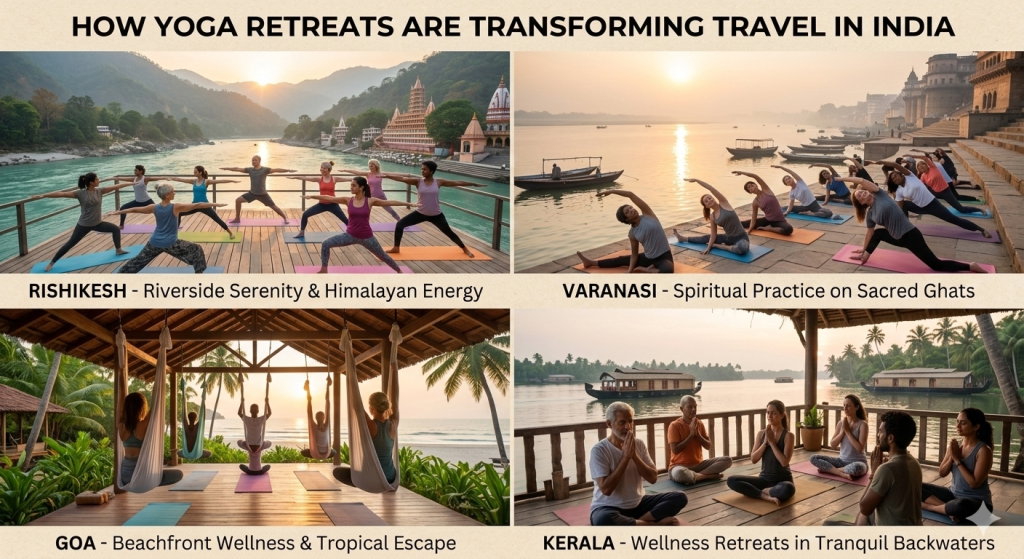
Kerala India’s southernmost state is the home of Ayurveda in its most classical form. Kerala-based retreats typically integrate yoga with Panchakarma cleansing therapies, Abhyanga massage, and medicinal herb treatments in lush tropical settings. The Kerala backwaters provide a uniquely peaceful environment for wellness travel.
Mysore, Karnataka Mysore is the birthplace of Ashtanga yoga as taught by Sri K. Pattabhi Jois at the Ashtanga Yoga Research Institute. For practitioners of the Ashtanga method, studying in Mysore is a pilgrimage. The city’s pace is slower and more contemplative than most Indian cities, making it ideal for extended stays focused on deepening a specific practice.
Goa Goa has evolved from a beach party destination into a significant wellness travel hub. Its combination of warm climate, international community, and growing number of quality retreat centres makes it particularly accessible for first-time wellness travellers from Europe and Australia.
Himachal Pradesh For those seeking solitude over community, the mountain villages of Himachal Pradesh offer some of India’s most remote and pristine retreat environments. Dharamsala, home of the Tibetan government in exile, adds a unique blend of Buddhist and yogic philosophy to the retreat experience.
Each destination offers a different expression of India’s wellness tradition. The best choice depends entirely on what the traveller is seeking: depth of study, physical renewal, spiritual community, or simply the experience of slowing down in a beautiful place.
H2: What Travellers Are Really Looking For
The yoga retreat traveller of 2025 is not who you might picture.
Research reveals that the fastest-growing demographic in wellness travel is not the committed yogi seeking advanced certification. It is the burned-out professional, the corporate executive, the new parent, and the recently retired person who has reached a point where something has to change and intuitively knows that the answer is not another holiday but a different kind of experience entirely.
A 2022 Global Wellness Summit report identified “preventive health travel” as one of the top ten wellness tourism trends globally. Travellers are increasingly seeking experiences that address the root causes of stress, fatigue, and disconnection rather than simply providing temporary relief from them.
Yoga retreats in India speak directly to this need. They offer not just relaxation but education. Not just rest but transformation. Not just a break from ordinary life but a reconsideration of how ordinary life might be lived differently on return.
The plot twist? Many travellers who come for a one-week retreat return the following year for a deeper programme. A significant number eventually pursue formal yoga teacher training, not necessarily to become teachers but to understand the practice at a level that transforms how they live.
H2: How to Choose the Right Yoga Retreat in India
With hundreds of options available, choosing the right retreat can feel overwhelming. Here is what actually matters when making the decision.
H3: Clarify Your Intention
A retreat for relaxation and nervous system recovery looks very different from a retreat for deepening a specific practice or pursuing teacher training. Being clear about your primary intention before you search filters the options considerably.
H3: Check the Teaching Lineage
Quality yoga retreats in India are rooted in a clear teaching tradition. Ask about the background and training of the lead teachers. Look for recognised certifications, particularly Yoga Alliance registration, which indicates alignment with internationally accepted standards of yoga education.
For travellers considering a more structured educational programme, a registered #yoga teacher training course in Rishikesh# provides a structured pathway into the deeper dimensions of practice with internationally recognised certification on completion.
H3: Consider the Length and Intensity
First-time retreat travellers often overestimate how much intensity they want. A one-week gentle retreat frequently produces more lasting benefit than an intense ten-day silent programme for someone whose nervous system is already depleted. Start with what feels sustainable and build from there.
H3: Read Real Reviews
Seek out reviews on platforms outside the retreat centre’s own website. TripAdvisor, Google Reviews, and community forums like Reddit’s r/yoga provide unfiltered perspectives from previous participants. Pay particular attention to reviews that describe the teaching quality and the post-retreat experience rather than just the facilities.
H3: Understand What Is Included
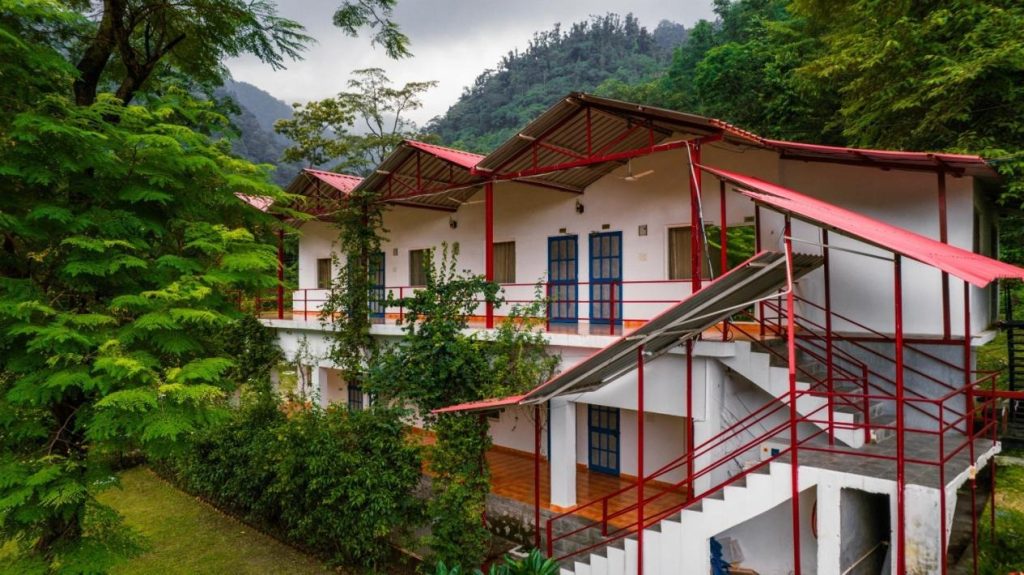
Accommodation standards vary enormously across India’s retreat centres. Confirm whether the price includes meals, what style of accommodation is offered, whether airport transfers are included, and what the refund or rescheduling policy is before booking.
Alt text: Simple clean accommodation at adhiroha – yoga teacher training centre in Rishikesh India with Himalayan view, representing authentic wellness travel experience
H2: FAQs: Yoga Retreats and Wellness Travel in India
Do I need to be an experienced yogi to attend a retreat in India? Not at all. Most retreat centres in India welcome complete beginners and design programmes that meet participants wherever they are in their practice. Some centres specialise specifically in beginners and first-time visitors. Communicate your experience level clearly when enquiring and choose a centre that explicitly welcomes your level.
What is the best time of year to visit Rishikesh for a yoga retreat? October to April is generally considered the best window. The weather is cool and clear, the Ganges is calm, and the mountain views are at their most vivid. March in particular coincides with the International Yoga Festival, which draws practitioners and teachers from around the world to Rishikesh for an exceptional concentrated week of practice and teaching.
How much does a yoga retreat in India typically cost? Costs vary enormously based on duration, accommodation standard, and programme depth. Budget ashram-style retreats can be as affordable as USD 30 to 50 per day inclusive of accommodation and meals. Premium boutique retreat centres can run USD 150 to 300 per day. A 200-hour yoga teacher training programme in Rishikesh typically ranges from USD 1,000 to 2,500 inclusive of accommodation, meals, and course materials.
Is it safe to travel to India for a yoga retreat as a solo female traveller? Rishikesh in particular has a well-established, internationally experienced wellness tourism infrastructure and is considered one of the safer destinations in India for solo female travellers. Staying within reputable retreat centres, using recommended transportation, and exercising standard travel awareness is sufficient for the vast majority of visitors. Many yoga retreat centres have a predominantly female international community.
.