Category: Travel and Wellness | Reading Time: ~6 min
Table of Contents
- Why Practicing Yoga in India Hits Differently
- Finding the Right City for Your First Yoga Trip
- Rishikesh: The Starting Point for Most Beginners
- What to Expect When You Arrive
- Types of Yoga Programmes Available
- Practical Travel Tips for First-Timers
- Packing for a Yoga Trip to India
India changed something in me that no other trip ever had.
That is the sentence you will hear repeated, in different words, by almost every traveller who has made the journey to India specifically for yoga. Not because India is magical in some vague, indefinable sense.
But because it is the one place on earth where yoga is not imported, adapted, or repackaged. It is simply home.
For a beginner considering this trip, the idea can feel equal parts exciting and overwhelming. Which city? Which school? Which style of yoga? How long to go for? Is it safe? Will I be good enough?
This guide answers all of it — practically, clearly, and without the rose-tinted filter that most yoga travel content applies to the subject.
H2: Why Practicing Yoga in India Hits Differently
Yoga was not invented in a California studio or a London wellness centre.
It emerged from this subcontinent over thousands of years, encoded in texts like the Yoga Sutras of Patanjali, the Hatha Yoga Pradipika, and the Bhagavad Gita. The teaching lineages that now span the entire globe trace their roots to specific ashrams, specific rivers, and specific teachers in specific Indian cities.
Practicing yoga in India is different from practicing it anywhere else for one simple reason: context.
When you sit with a teacher who has studied the same texts in the same language they were originally written in, the practice stops being exercise and starts being education. When you practice pranayama at sunrise on the banks of the Ganges, the breath work stops being technique and starts being experience.
Research reveals that immersive yoga environments produce significantly greater reductions in stress, anxiety, and burnout compared to regular studio classes, according to a study published in the Journal of Alternative and Complementary Medicine. The environment is not incidental. It is part of the medicine.
Beyond all of this, India offers extraordinary practical value. World-class yoga schools, deeply experienced teachers, Ayurvedic clinics, and mountain or coastal environments combine at a price point that makes extended stays genuinely accessible for international travellers from virtually any budget level.
H2: Finding the Right City for Your First Yoga Trip
India is vast. And not every part of it is equally suited to a first yoga trip.
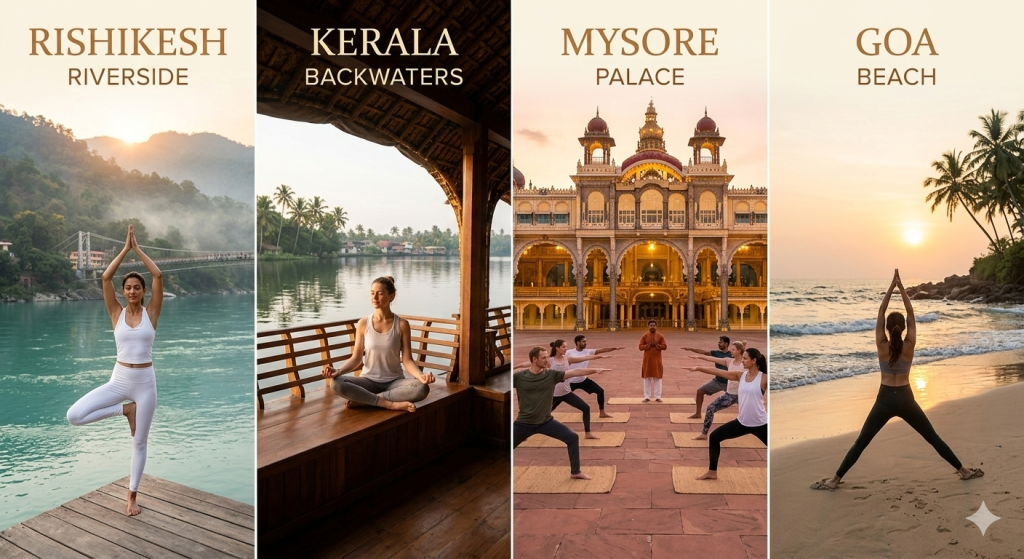
The good news is that for beginners, the choice narrows quickly once you know what you are looking for. Here are the four destinations most commonly recommended for first-time yoga travellers to India.
H3: Rishikesh, Uttarakhand
The undisputed yoga capital of the world. Rishikesh sits in the Himalayan foothills where the Ganges emerges from the mountains, offering a combination of natural beauty, spiritual atmosphere, and concentrated yoga infrastructure that no other Indian city can match. It is the top recommendation for most first-time yoga travellers and the subject of most of this guide.
H3: Kerala
India’s southernmost state is the classical home of Ayurveda. Kerala-based retreats integrate yoga with Panchakarma cleansing, Abhyanga oil massage, and medicinal herb treatments in lush tropical backwater settings. Ideal for travellers whose primary goal is physical renewal and Ayurvedic healing rather than yogic study.
H3: Mysore, Karnataka
The birthplace of Ashtanga yoga as taught by the legendary Sri K. Pattabhi Jois. Mysore is a pilgrimage destination for Ashtanga practitioners specifically. For beginners with no existing Ashtanga practice, Rishikesh or Kerala are more appropriate starting points.
H3: Goa
Increasingly popular with European and Australian wellness travellers for its warm climate, beach environment, and accessible international community. Goa offers a gentler, more lifestyle-focused introduction to yoga travel compared to the immersive intensity of Rishikesh. A good option for travellers who want to dip a toe in before committing to a deeper programme.
Image Prompt: Split panel showing four Indian yoga destinations: Rishikesh riverside, Kerala backwaters, Mysore palace, and Goa beach at sunset. Clean travel magazine aesthetic, warm colours. Alt text: Four top yoga destinations in India for beginners: Rishikesh, Kerala, Mysore, and Goa for wellness travel and yoga retreats
H2: Rishikesh: The Starting Point for Most Beginners
If you are reading this guide as a complete beginner with no strong preference for a specific yoga style or destination, start here: go to Rishikesh.
Here is why it works so well for first-timers specifically.
Rishikesh has an entire ecosystem built around supporting yoga travellers at every level. The city has hundreds of yoga schools, ashrams, and retreat centres ranging from free or low-cost ashram stays to premium boutique retreat experiences. The international community of yoga travellers means you will never feel out of place as a foreigner or a beginner.
The Ganges provides a constant grounding presence. The Himalayan foothills offer spectacular trekking and nature access between practice sessions. The local food scene is almost entirely vegetarian and Sattvic, which supports the dietary dimension of the yogic lifestyle naturally.
Laxman Jhula and Ram Jhula, the two famous suspension bridges crossing the Ganges, connect the main yoga neighbourhoods and are themselves iconic landmarks in the global yoga world.
Pay attention to this: the International Yoga Festival held in Rishikesh each March draws master teachers and practitioners from across the world for an extraordinary concentrated week of classes, workshops, and cultural events. Timing your first visit to coincide with it can be a genuinely life-changing introduction to the global yoga community.
Structured programmes in Rishikesh range from weekend drop-in retreats to month-long immersions. For beginners wanting a structured introduction to classical yoga philosophy, asana, and pranayama, a #yoga teacher training course in Rishikesh# provides a thorough, well-sequenced entry point into the practice even for those with no intention of teaching.
H2: What to Expect When You Arrive
First-time travellers to India are often surprised by how different the reality is from both their fears and their expectations.
India is loud, colourful, chaotic, and deeply alive in a way that is genuinely difficult to describe before experiencing it. Rishikesh is considerably calmer than most Indian cities, but it is still India. The traffic, the street dogs, the temples, the chai vendors, and the constant background hum of a city built on the banks of a sacred river are all part of the experience.
Here is what most yoga travel guides do not tell you: the first few days in India are often disorienting. Jet lag combines with sensory overload, unfamiliar food, and the sudden removal of all your usual routines. This disorientation is normal. It is also, from a yogic perspective, part of the practice.
The structured rhythm of a yoga programme, once it begins, provides enormous grounding. The early mornings, the set meal times, the practice schedule, and the community of fellow practitioners create a new routine that quickly becomes steadying.
Practically speaking, here is what arrival in Rishikesh typically involves:
- Flying into Jolly Grant Airport (Dehradun), approximately 35 kilometres from Rishikesh town
- Pre-arranged pickup from your yoga school or a pre-booked taxi from the airport
- A brief orientation period settling into accommodation before your programme begins
- First meals in the school or local restaurants, almost entirely vegetarian
- First practice session, typically the morning after arrival to ease jet lag through movement
Most quality yoga schools in Rishikesh will send you detailed pre-arrival information covering all logistics. If they do not, ask. Good schools communicate clearly before you even board the plane.
H2: Types of Yoga Programmes Available for Beginners
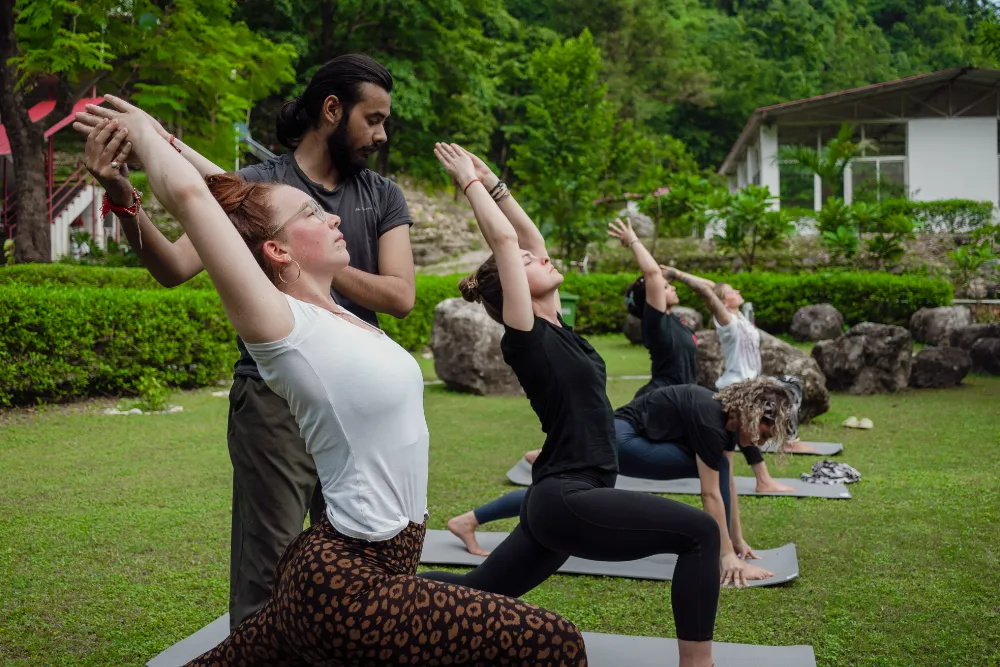
One of the most common confusions for first-time yoga travellers is understanding the difference between the programme types available. Here is a clear breakdown.
H3: Drop-In Classes
Single classes attended without any ongoing commitment. Ideal for travellers who want to sample different teachers and styles before committing to a longer programme. Most schools in Rishikesh offer drop-in classes at very accessible prices.
H3: Short Retreats (3 to 7 days)
Structured programmes with a fixed daily schedule, accommodation, and meals included. Retreats of this length are ideal for travellers with limited time or those wanting a first experience before committing to a longer immersion. They will not produce the deep transformation of a longer stay but are an excellent introduction.
H3: Yoga Teacher Training (200 Hours)
Here’s where it gets interesting. Many people assume a yoga teacher training is only for aspiring teachers. In reality, a significant proportion of participants on any given 200-hour training have no intention of teaching professionally.
They are there because the 200-hour format provides the most thorough, structured, and transformative introduction to yoga available anywhere. It covers asana, pranayama, philosophy, anatomy, meditation, and Ayurveda in a depth that no retreat or drop-in class can match.
A #200 hour yoga teacher training in Rishikesh# is internationally recognised through Yoga Alliance and provides a globally accepted qualification that carries weight whether you use it professionally or simply as a marker of genuine study. For a first-time yoga traveller with three to four weeks available, it is the single most transformative option on the table.
H3: Longer Immersions (300 and 500 Hours)
Advanced programmes for practitioners who have already completed foundational training and wish to deepen their practice and teaching capability. Not recommended as a first programme for genuine beginners.
Alt text: International yoga students attending a yoga teacher training class in a traditional shala in Rishikesh India
H2: Practical Travel Tips for First-Timers
A few things worth knowing before you book the ticket.
Visa: Most nationalities can obtain an Indian e-Visa online before departure. The process is straightforward and takes two to four business days. Apply at least two weeks before travel to allow for any delays.
Best time to visit Rishikesh: October through April offers the clearest weather, coolest temperatures, and most comfortable conditions for intensive practice. May through September is monsoon season. The heat and humidity make practice uncomfortable and some mountain roads become inaccessible.
Health precautions: Consult your doctor about recommended vaccinations four to six weeks before departure. Hepatitis A, Typhoid, and Tetanus are commonly recommended for India travel. Travel insurance that covers medical evacuation is strongly advised.
Money: ATMs are widely available in Rishikesh. Inform your bank of your travel dates before departure to avoid cards being blocked. Most yoga schools accept international bank transfers for course fees in advance.
Connectivity: SIM cards with generous data plans are available cheaply at the airport on arrival. Airtel and Jio are the most reliable networks in Rishikesh. Most yoga schools also have Wi-Fi, though many encourage a digital detox during the programme.
Altitude: Rishikesh sits at approximately 350 metres above sea level, which is not high enough to cause altitude sickness. However if you plan to trek in the surrounding Himalayas, acclimatise gradually and follow local guide advice.
H2: What to Pack for a Yoga Trip to India

Less is genuinely more for this kind of travel.
Clothing: Lightweight, breathable, modest clothing is essential. India is a conservative culture and covering shoulders and knees in public spaces is both respectful and practical. Yoga-specific practice wear can be purchased cheaply in Rishikesh if needed.
Yoga mat: Many schools provide mats but bringing your own is always preferable for hygiene and familiarity. A lightweight travel mat is sufficient.
Medications: Bring a basic travel medical kit including rehydration sachets, antidiarrheal medication, antihistamine, and any prescription medications you take regularly in sufficient supply for your entire trip plus a buffer.
Documents: Passport, printed e-Visa, travel insurance documents, and a copy of your school confirmation letter. Keep both physical and digital copies.
Open mind: Pack this above everything else. The single variable that most predicts a transformative yoga trip to India is the willingness to be surprised, challenged, and changed by the experience.
Image Prompt: Neatly organised travel flatlay including a yoga mat, lightweight clothing, passport, travel journal, herbal teas, and a small first aid kit on a wooden surface, clean and practical aesthetic. Alt text: Essential packing list for a yoga travel trip to India including yoga mat, modest clothing, travel documents, and wellness essentials