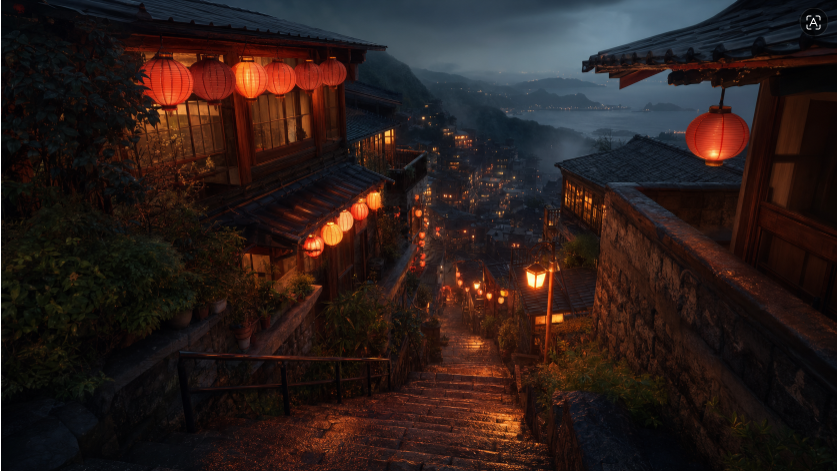
Jiufen is a former gold-mining town on the northeast coast of Taiwan, about forty kilometres and an hour from Taipei, and the single most popular day trip from the capital. Its red lanterns, narrow staircase alleys, hillside teahouses and ocean views make it famous, often linked, though Hayao Miyazaki denied it, with the look of Spirited Away. The core of a visit is Jishan Old Street, the iconic A-Mei Teahouse, and signature snacks like taro balls, best enjoyed either before nine in the morning or in the evening when the lanterns glow and the tour buses have gone.
From Gold Rush to Global Fame
Jiufen’s name, meaning nine portions, supposedly dates to an isolated Qing-dynasty village of nine families who ordered nine shares of supplies whenever ships arrived. Gold discovered in the 1890s turned the hillside into a boomtown that peaked under Japanese colonial rule, leaving the dense, back-to-back wooden buildings and former inns that still define its silhouette. The mines closed in 1971, and the town faded until the acclaimed 1989 film A City of Sadness, set here, sparked its tourism revival.
Understanding that history changes how you read the streets. The cramped lanes and stone staircases are not picturesque set dressing but the actual logic of a mining settlement squeezed onto a steep slope above the sea. Old mining tunnels still pock the town, one now forms the entrance to a teahouse, and the handsome 1934 Shengping Theater, built of Taiwanese cypress, once anchored Jiufen’s social life and remains free to wander.
Walking Jishan Old Street
The heart of town is Jishan Street, a covered labyrinth of teahouses, pottery stores, souvenir stalls and food vendors that begins beside the 7-Eleven at the main bus stop and meanders uphill. You can walk it top to bottom in half an hour, but most visitors take two or more hours, drifting with the crowd through the jam-packed central stretch. Beyond the Jishan viewing platform the lanes quieten and turn pleasingly local.
The most photogenic moment is the staircase that drops from the Old Street toward the A-Mei Teahouse and the Shengping Theater, a frame of stone steps, hanging lanterns and rooftops tumbling to the ocean. It is gloriously crowded, so go with the flow rather than against it, and remember the whole town is built on stairs, comfortable shoes matter more here than almost anywhere else in Taiwan.
The A-Mei Teahouse and the Spirited Away Myth
The multi-storey, lantern-draped A-Mei Teahouse is the most photographed building in Jiufen and the one everyone associates with the Ghibli aesthetic. Inside, a tea set buys you a choice of high-mountain oolong served kung-fu style with enough leaves for many pots, alongside little treats of mochi, green bean cake, sesame crackers and sweet plums, all enjoyed from a balcony facing Keelung Mountain. It takes no reservations now, so arrive off-peak, late morning or right at opening, to avoid the afternoon queue.
About that legend: Miyazaki himself stated Jiufen did not inspire Spirited Away, pointing instead to Dogo Onsen in Japan and a blend of influences. The myth persists because the red-lantern alleys genuinely evoke the film, especially at dusk or in the rain, and the town happily sells No-Face masks and Totoro figures to lean into it. For the classic exterior photograph, shoot from the Skyline Tea House across the lane as the lanterns switch on. Planning a smooth Jiufen day trip around these timings is what separates a magical visit from a shoulder-to-shoulder slog.
What to Eat: Taro Balls and Beyond
Jiufen’s signature is the taro ball, a chewy dessert of hand-rolled taro and sweet potato served hot in syrup or cold over shaved ice with beans. The famous shops are Lai Ah Po on the Old Street and Ah Gan Yi up a staircase, the oldest in town, where the reward for the climb is a hilltop view to eat them by. Watching the dough being rolled is half the pleasure.
Save room for the rest of the lineup. The A-Zhu peanut ice cream roll wraps ice cream, shaved peanut brittle and coriander in a thin crepe, the sixty-year-old Fish Ball Bozai ladles out fish ball soup and stuffed tofu, and the lanes hide braised pork rice, herbal rice cakes, grilled squid and pineapple cakes. Most are tiny hole-in-the-wall counters, some with view balconies, so graze your way down the street rather than seeking one big meal.
Getting There from Taipei, and Back
The reliable route is train plus bus: ride any northbound TRA train from Taipei Main Station to Ruifang in about forty minutes, walk a couple of hundred metres to the bus stop, then catch bus 788, 856 or 965 up to the Old Street, the whole trip costing around sixty-five NTD. Direct buses also run, the 965 from Ximen and the 1062 from MRT Zhongxiao Fuxing, taking around eighty to a hundred minutes with no transfer.
Taxis or a private car run about forty-five minutes and suit groups, though drivers can no longer drop at the Old Street entrance and now use a nearby lot a short walk away. Plan the return before you relax into the evening: buses fill fast after five or six, the last direct bus leaves around half past nine, and the final Ruifang trains run late into the night. Travelling light makes the packed return bus far more bearable.
Timing, Crowds, and What to Pair It With
Jiufen is busy every single day, peaking from early afternoon into early evening, so the winning windows are before nine in the morning or from late afternoon onward. Weekdays beat weekends, and unusually for Taiwan the town stays open on Mondays, making Monday a quietly clever choice. Misty, drizzly days actually improve the mood, wet cobblestones mirror the lantern light and thin the crowds.
Because it sits among other northeast-coast gems, Jiufen pairs naturally into a fuller day. Ten minutes on lead to the Jinguashi Gold Museum, where you can touch a giant gold bar and enter old mining tunnels, and the orange-bedded Golden Waterfall lies just downhill. Shifen, with its waterfall and sky lanterns, and Yehliu Geopark with its Queen’s Head rock are common partners, the reason so many visitors fold Jiufen into a single looping itinerary.