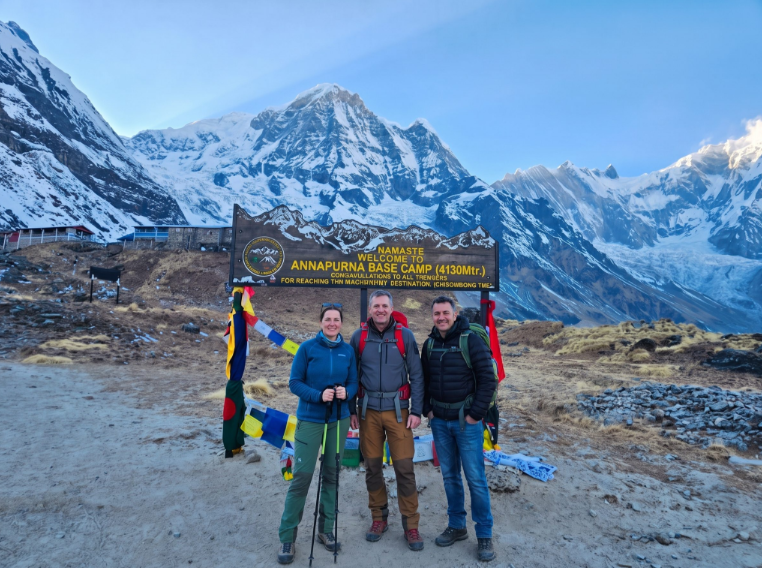
Three Annapurna Treks, Three Very Different Experiences
You’ve got maybe ten days in Nepal, a decent level of fitness, and three Annapurna routes open in browser tabs that all look, frankly, incredible. Snow walls, turquoise skies, a lone trekker silhouetted against a ridge. The photos don’t help much, because all three treks photograph beautifully and none of them tell you what the actual walking will feel like.
That’s the real question behind most searches for the Annapurna Base Camp trek, the Mardi Himal trek, or the Khopra Danda trek. Not “which one is prettiest,” but which one fits the time you actually have, the legs you’re bringing, and the kind of week you want to remember.
These aren’t three flavors of the same hike. The route shape, the altitude profile, the rhythm of each day, even the mood on the trail — all of it differs more than you’d expect from three treks that sit within a few valleys of each other. ABC pulls you into a mountain amphitheater. Mardi puts you up on an open ridge early and keeps you there. Khopra takes you somewhere quieter, where you’re less likely to be sharing a teahouse dining room with forty other trekkers.
This piece compares route character, best time to go, cost, difficulty, scenery, and overall experience, so you can pick based on what you’re actually after rather than which thumbnail caught your eye first.
Annapurna Base Camp vs Mardi Himal vs Khopra Danda at a Glance
| Feature | Annapurna Base Camp Trek | Mardi Himal Trek | Khopra Danda Trek |
| Typical trekking time | 7–11 days | 5–7 days | 6–9 days |
| Main character | Sanctuary/base camp journey | High open ridge | Quiet ridge, community lodges |
| Highest main point | ~4,130 m at ABC | ~4,200 m at Upper Viewpoint, some itineraries higher | ~3,660 m at Khopra Danda |
| Optional high point | — | Mardi Himal Base Camp area | Khayer Lake, well above 4,000 m |
| Main scenery | Sanctuary walls, Machhapuchhre, deep valleys | Machhapuchhre, Annapurna South, open ridge | Dhaulagiri, Nilgiri, Kali Gandaki valley |
| Difficulty | Moderate | Moderate, with a tough high-altitude day | Moderate to moderately hard |
| Best for | First big Annapurna trek, classic experience | Short trek, huge ridge views | Quieter trail, off-the-main-line feel |
A quick note before we go further: don’t take altitude figures as gospel. Mardi Himal and Khopra Danda trek in particular have several route variations, and where an operator draws the “highest point” line changes depending on which extension they include. The itinerary matters more than the number on the poster.
The Routes Feel Different From the First Day
Annapurna Base Camp — Into the Mountain Amphitheatre
Most ABC routes start from the Pokhara side, working through Ghandruk or a similar entry village, then following the Modi Khola upstream. Chhomrong is usually the pivot point where the trail properly commits to the valley. From there the walls close in gradually — forest gives way to bamboo and rhododendron, then to bare rock and glacial moraine, and eventually you’re standing in the Sanctuary itself with Annapurna I, Machhapuchhre, and a ring of other giants boxing you in on every side.
What makes ABC distinctive isn’t any single viewpoint. It’s the sense of progression. Every day the peaks get a little closer and a little bigger, and the final push into base camp has a genuine feeling of arrival, like you’ve been let into somewhere rather than just walked to a lookout point. The Annapurna Conservation Area itself spans a huge range of terrain, from mid-hill forest villages up to properly high alpine ground, and ABC is really a walk through most of that spectrum in one trip.
Mardi Himal — Climb the Ridge Instead of Following a Valley
Mardi typically starts near Kande or Phedi, both a short drive from Pokhara, and heads up through forest toward Forest Camp, then Low Camp, High Camp, and finally the Upper Viewpoint. Unlike ABC, there’s no long valley walk here — you’re gaining a ridge fairly early and staying on it.
That’s the whole personality of the trek. It’s about elevation and exposure rather than immersion. The trail breaks out of rhododendron forest onto open ground, and from that point on Machhapuchhre — Fishtail Peak — dominates the view almost constantly. Standard itineraries top out around the 4,200 m viewpoint, though some operators extend the trip further toward a Mardi Himal Base Camp area closer to 4,500 m. It’s a shorter commitment than ABC, but it front-loads a lot of altitude gain into a compressed number of days, which matters more than people expect.
Khopra Danda — A Quieter Ridge Journey
Khopra routes usually branch off from the Ghandruk or Tadapani side, moving through Bayeli Kharka and Chistibung before reaching the ridge at Khopra Danda itself. Some itineraries also link in from the Ghorepani/Poon Hill side, depending on the operator.
The defining feature isn’t the altitude — at around 3,660 m, Khopra Danda is lower than the ABC or Mardi high points — it’s the quiet. Fewer trekkers use this route, lodges are smaller and more locally run, and there’s a real sense of being somewhat away from the busiest Annapurna corridors. For travelers who’ve already done a popular teahouse trek and want something with a bit more solitude, this is usually the one that scratches that itch. The optional side trip to Khayer Lake pushes well above 4,000 m and changes the character of the day considerably — it’s a proper high-altitude excursion, not a stroll.
Which Trek Has the Better Scenery? It Depends on What You Want to See
There isn’t a “best” here, honestly — it comes down to what kind of view you find more compelling.
ABC gives you an enclosed, almost theatrical scene: mountain walls rising on every side, Machhapuchhre and Annapurna South looming close, and a forest-to-alpine transition that unfolds gradually as you walk deeper into the valley. Traditional Gurung villages along the way add a lived-in texture to the trek that a lot of people remember as fondly as the mountains themselves.
Mardi feels more open. Machhapuchhre appears earlier and stays visible for longer stretches, and because you’re on a ridge rather than in a valley, the panorama is wider even if the peaks themselves aren’t quite as close. Rhododendron forest lower down gives way to bare, windswept ground higher up, and sunrise from the upper camps is one of the better payoffs on any short Nepal trek.
Khopra’s signature view is Dhaulagiri, with Annapurna South and Nilgiri filling out the rest of the panorama and the Kali Gandaki valley cutting through the landscape below. It’s a broader, more horizontal kind of scenery compared to ABC’s vertical drama, and the alpine meadows along the ridge add a softer element that some trekkers find more restful than the raw rock of the Sanctuary.
Difficulty: The Shortest Trek Isn’t Automatically the Easiest
This trips people up more than anything else on this list. Mardi Hima Trekl being shorter doesn’t mean it’s gentler.
ABC’s difficulty comes from duration and cumulative altitude rather than anything technical — you’re walking for a week or more, with repeated climbs and descents on stone steps, and the final days involve real altitude even though the peak height (around 4,130 m) isn’t extreme by Himalayan standards.
Mardi compresses a similar altitude gain into far fewer days. The climb toward High Camp is steep, and the long day up to the viewpoint — sometimes pushed further toward the higher base camp area — can catch people off guard who assumed “five days” meant “easy.” Add exposed, windy sections on the open ridge and it’s a trek that rewards being properly prepared, not underestimated because of its length.
Khopra sits somewhere in the middle on paper, but the optional Khayer Lake day changes that equation. Reaching well above 4,000 m on a side trip turns what would otherwise be a moderate trek into something considerably more demanding for that one day.
Worth saying plainly: altitude illness doesn’t care which trek you’re on. Anywhere above roughly 2,500 m, take symptoms seriously — headaches, nausea, and disturbed sleep are your body telling you something, and the right response is usually to slow down or descend, not push through.
Best Time: The Same Season Doesn’t Feel the Same on Every Trail
Broadly, September through November and February through May are the strongest windows for trekking in Nepal, and that holds true across all three of these routes. But the way each season plays out differs depending on where you’re walking.
On ABC, both spring and autumn are safe, reliable choices for clear mountain views, and spring adds the bonus of rhododendron forests turning red and pink on the lower sections — genuinely one of the better reasons to time a spring trip here.
Mardi is particularly attractive in spring for that same forest color, but because so much of the trail is exposed ridge, wind becomes more of a factor than it is on ABC. Autumn tends to bring the clearest, calmest conditions up top.
Khopra suits both seasons reasonably well too, with spring bringing flowering forest lower down and autumn generally delivering the sharpest mountain panoramas from the ridge.
Monsoon season isn’t a flat “don’t go” — it’s more that visibility and trail conditions become less predictable, and that unpredictability matters more on some routes (exposed ridges, river crossings) than others.
Cost: Where Your Money Actually Goes
There’s no single honest price tag for any of these treks, because so much depends on group size, trip length, whether you’re hiring a private guide and porter, transport arrangements, and the standard of the teahouse you’re booking into.
As a rough planning guide based on current package pricing from Nepali trekking operators: ABC packages commonly run somewhere around US$600–1,300, Mardi Himal trips are typically cheaper at around US$350–1,000, and Khopra Danda packages tend to land around US$490–800 or a bit above, with fully private or custom arrangements pushing higher on all three.
Take these as ranges to sanity-check quotes against, not fixed prices. The more useful habit is to stop comparing headline numbers between agencies and start comparing what’s actually included — permits, guide and porter fees, meals, accommodation, transfers in Pokhara, transport between Kathmandu and Pokhara, insurance, and what happens if something goes wrong at altitude.
The Experience Matters More Than the Numbers
If you want the feeling of walking progressively deeper into a major Himalayan sanctuary and reaching a genuinely famous destination, ABC is the one that delivers that arc.
If your priority is a shorter trip with big ridge views and Machhapuchhre pulling your eye for most of the walk, without committing to a longer valley trek, Mardi Himal makes more sense.
If you want something a little less trodden — high-ridge scenery, smaller lodges, more space between you and the next group of trekkers — Khopra Danda is usually the better fit.
Beyond the numbers, it’s the small things that stick with people afterward: a teahouse dining room warmed by a wood stove after a cold day, the way the forest changes character every thousand meters, the specific quiet of standing on a ridge above cloud line. Walking through a valley and standing above one are genuinely different experiences, and that’s really what you’re choosing between here.
For travelers sorting out permits, guides, transport, and accommodation through a local operator, Adventure Master Trek is one company worth looking at when comparing organized Annapurna trekking arrangements.
What to Check Before Booking Any of the Three
Whichever route you land on, ask the agency these questions before handing over a deposit: the exact route and number of trekking days, the highest sleeping altitude on the itinerary, whether a licensed guide is included, whether permits are covered, whether Pokhara transfers and transport are included, whether a porter is part of the package, what happens if weather forces an itinerary change, what emergency or evacuation support is available, and whether meals and accommodation are covered for the whole trek — not just some nights.
If you’re hunting for the best trekking agency in Nepal, resist judging on price or website polish alone. The itinerary detail, how clearly they explain inclusions, and how seriously they take safety planning tell you a lot more than a slick homepage ever will.
Final Take — Three Treks, Three Reasons to Go
Annapurna Base Camp is the classic sanctuary journey — the one with the strongest sense of arrival. Mardi Himal is shorter and higher-feeling, with Machhapuchhre holding your attention almost the whole way. Khopra Danda is quieter, Dhaulagiri-facing, and gives you more distance from the main trekking crowds.
None of them is objectively “the best Annapurna trek.” The right one depends on how much time you’ve got, how you like to walk, how you handle altitude, and honestly, what kind of story you want to tell about this trip once you’re home.
FAQs About Annapurna Base Camp, Mardi Himal and Khopra Danda
Which is better for a first-time trekker: ABC, Mardi Himal, or Khopra Danda?
It depends on how much time and preparation you have. ABC suits someone wanting a longer, classic first Himalayan trek. Mardi fits a shorter trip if you’re reasonably fit and ready for a steep push near the top. Khopra works well for someone who’s trekked before and wants a quieter route this time.
Is the Mardi Himal trek harder than Annapurna Base Camp?
Not exactly harder, but more compressed. Mardi packs similar altitude gain into fewer days, with a demanding upper-ridge push, while ABC spreads the effort over a longer, more sustained walk.
Which trek has the best mountain views?
Depends on taste. ABC gives you an enclosed sanctuary feel, Mardi delivers open ridge panoramas centered on Machhapuchhre, and Khopra offers wide views toward Dhaulagiri and Nilgiri.
What’s the best month for the Annapurna Base Camp trek?
Spring and autumn are the main windows, generally offering the clearest skies and most stable trail conditions, though exact weather varies year to year.
How much does it cost to trek to ABC, Mardi Himal, or Khopra Danda?
Costs vary with group size, guide and porter arrangements, permits, transport, and accommodation standard. Use the comparison above as a planning range rather than a fixed quote, and always check what’s included before comparing agencies.
Do I need a guide for these Annapurna treks?
Guide and permit requirements for trekking in protected areas have changed in recent years, so check the current rules directly with Nepal’s tourism authorities or your operator before you go, rather than relying on older information.